Bespoke L3 applications
Tracking, dispositioning, yard management, shift reporting, certificate generation — the modules your chosen platform priced out of scope.
Four service lines, all pointed at the same problem: metals plants run on decisions that software should be making better, and most software does not understand metals.
Independent advice from people who have been the customer, the implementer and the product owner — often on the same programme.
Most MES programmes do not fail on technology. They fail because the scope was drawn by someone who had never watched a shift handover, or because a platform was chosen before anyone agreed what Level 3 was supposed to own. We help you get those two things right before you spend the money.
Where you actually are against ISA-95, and the three gaps that matter most.
Requirement sets written in mill language, scored without vendor theatre.
Honest, including the cases where the honest answer is "buy, and not from us".
What lives at L2, what lives at L3, what belongs in ERP — and who owns each field.
A second opinion on an implementation that has stopped moving.
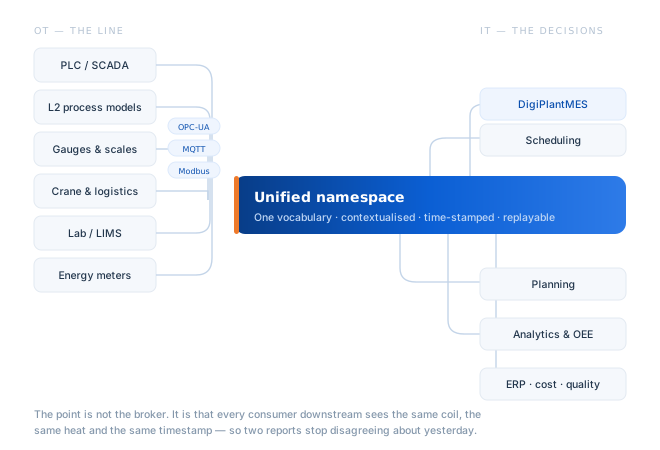
Industry 4.0 without the poster. Connect the line, make the data trustworthy, then automate the decisions that cost real money.
Most plants already have more data than they use. The problem is that the caster system, the mill system and the weighbridge each call the same piece of steel something different — so nobody trusts a number that crosses a boundary. That is the first thing we fix.
Get signals off the line reliably and put them in one place with one naming convention. Usually 6–10 weeks per area.
Reconcile against physical counts and lab results until the numbers stop being argued about in the morning meeting.
Only now automate: scheduling, yield decisions, quality dispositioning, energy. This is where the money is.
Industrial software has to survive a plant: 24/7 operation, unreliable networks, users wearing gloves, and a change window that opens twice a year. We build for that.
Tracking, dispositioning, yard management, shift reporting, certificate generation — the modules your chosen platform priced out of scope.
Oracle Forms, VB6, Delphi and 20-year-old C on a machine nobody wants to reboot. Migrated incrementally, with the old system still running.
L2 ↔ L3 ↔ ERP message handling with configurable field mapping, replay, and a dead-letter queue you can actually read.
Generate realistic L2/L3 traffic so you can test the new system before the line is available — not during commissioning weekend.
Yard and stockyard visualisation, stacking rules, crane routing — rendered so a planner can see the constraint instead of reading it.
Semantic versioning, per-customer release trains, database migrations handled properly. Upgrades stop being an event.
Chosen for total cost of ownership over a 10-year plant lifecycle, not for what is fashionable this year.
The hardest thing to hire in this industry is not a developer. It is someone who understands why a heat cannot simply be re-sequenced, and can also write the specification.
Functional and technical consultants with hands-on PSImetals implementation experience — Planning, Production, Quality and Logistics modules.
People who can sit with a caster foreman in the morning and write a workable functional spec in the afternoon.
Melt shop, hot mill, cold mill and finishing-line scheduling logic — plus the S&OP layer above it.
Tell us the module, the phase and the location. We will come back with availability rather than a brochure.
Send a resource requestDigiPlantMES is our own MES for metals — and we are selecting a small number of design partners to shape it against real operations.