Home / Scheduling

Metals scheduling is not generic APS.

A caster sequence, a rolling programme and a paint line campaign obey completely different rules — and none of them are "minimise makespan". We build a scheduler per unit, on a shared model, so the whole route stays connected.

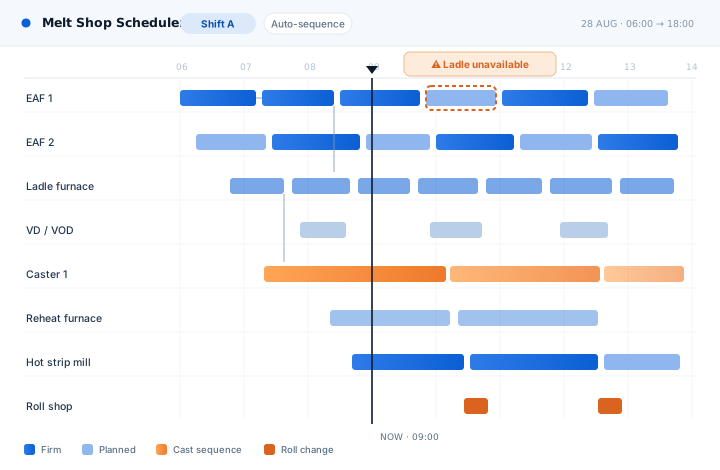
Scheduling board showing heats across EAF 1, EAF 2, ladle furnace, degasser and caster, then reheat furnace and hot strip mill, with a now line, roll change markers and a ladle availability conflict highlighted.
One board, whole route — melt shop through mill, with constraints visible

Constraints, not preferences

A tundish has a life. A ladle is either available or it is not. The scheduler treats physics as hard and commercial priority as soft — never the other way round.

Re-plan in seconds

When a caster goes down, the question is what to do with the twelve heats already tapped. The answer needs to arrive before the next one does.

Planner in the loop

Auto-sequence proposes, the planner disposes. Manual overrides are first-class and are recorded with a reason, not fought against.

01 · Melt shop

SMS Scheduler

Heat-level sequencing through EAF or BOF, ladle furnace, degasser and caster — the tightest coupling in the plant, and the one where a mistake costs a skulled ladle.

  • Grade grouping — heats sequenced so chemistry transitions stay inside practice limits
  • Ladle and crane availability as hard constraints, including preheat and relining cycles
  • Treatment routing — LF, VD/VOD and wire feed steps selected from the grade practice
  • Cast-ready timing — tap-to-cast windows respected so the caster is never starved or blocked
  • Energy awareness — melt scheduling against tariff windows and peak demand limits

Decisions it takes off the planner

Which furnace, which heat, which order

Balanced across furnaces rather than filled first-come.

When to start, to hit the cast

Backwards from the caster, not forwards from the scrap bay.

What to do when one goes wrong

Re-sequence proposals with the downstream impact shown before you commit.

Sequence rules we model

Width transitions

Step sizes constrained by mould and segment settings, with flying-width-change capability where the caster supports it.

Tundish life

Sequence length capped by tundish age and expected wear, with planned change points rather than surprise ones.

Grade families

Compatible grades cast back-to-back; transition slabs identified and dispositioned automatically.

Slab-to-order matching

Cut plans that maximise order coverage instead of producing well-formed stock nobody ordered.

02 · Casting

Caster Scheduler

Sequence building that treats the cast as the atomic unit. Because once you start a sequence, your options for the next four hours are largely gone.

The interesting tension in caster scheduling is between the long, clean, cheap sequence and the order book that wants six widths and four grades this week. We surface that trade-off explicitly — cost of transition against cost of lateness — rather than burying it in a weight in an objective function nobody can explain.

Cast length optimisation

Longer sequences where the order book permits, shorter where lateness costs more.

Transition penalties

Priced in tonnes of downgrade, so the trade-off is in a unit the plant understands.

03 · Rolling

Mill Schedules

Hot strip and plate rolling programmes that respect what the rolls are doing to themselves while they work.

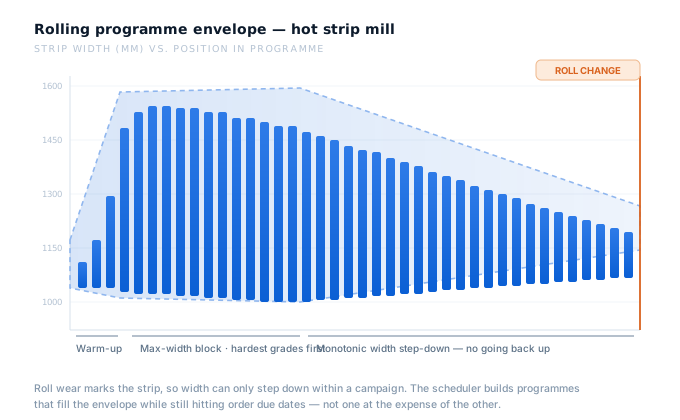
Work rolls wear and pick up thermal crown as a campaign progresses, and that wear prints itself onto the strip. So width can only step down within a campaign, the hardest and widest material goes early after the warm-up coils, and every programme ends at a roll change. The scheduler builds programmes that fill that envelope while still hitting due dates — the whole craft is in doing both at once.

  • Campaign envelope — width step-down, gauge and hardness progression enforced
  • Roll wear and roll change points planned, with roll shop capacity as a constraint
  • Warm-up and transition coils selected from stock rather than from good orders
  • Slab availability checked against the yard and the reheat furnace, not assumed
  • Plate mills — pattern nesting and cut-to-order planning where applicable
Chart of strip width against position in the rolling programme, showing the coffin-shaped feasible envelope, warm-up coils, a maximum width block, monotonic width step-downs and the roll change.
The rolling programme envelope — width can only step down
04 · Finishing lines

Cold Mill · Galvanising · Paint Lines

Downstream is where the order book gets specific and the campaign rules get awkward. Each line has its own idea of what a good run looks like.

Cold mill

Reduction schedules linked back to hot band availability, with width and gauge grouping to limit pass-line changes.

  • Hot band coverage checked before the programme is issued
  • Roll change and grinding capacity as constraints
  • Anneal batch grouping downstream of the mill
Galvanising line

Coating-weight blocks and pot chemistry campaigns — the two things that decide how much you can reshuffle on the day.

  • Coating weight sequenced in blocks, transitions minimised
  • Pot changes and grade families planned together
  • Line speed and thickness compatibility windows

Paint lines

Colour campaigns are the classic case: light to dark, minimise flushes, and never let an urgent order justify a colour change that costs an hour of line time.

  • Colour sequencing with flush and purge cost modelled
  • Primer, topcoat and backcoat combinations
  • Customer-specific colour approvals held with the order
05 · Forging

Forging Scheduler

Press and hammer loading where the furnace, not the press, is usually the real constraint — and where a die change can cost more than the job it enables.

  • Furnace soak times and charge grouping by section size and grade
  • Die changeover sequencing to cluster jobs sharing tooling
  • Press and hammer capacity including manipulator and handling constraints
  • Heat treatment batching — normalise, quench and temper cycles grouped across orders
  • Machining and inspection downstream, so the promise date reflects the whole route

Also modelled on request

Sinter & pellet plant

Pickling lines

Tube & pipe mills

Extrusion presses

Rod & wire

Bar & section mills

The modelling approach transfers. Tell us the unit, its campaign rules and what a bad sequence costs you, and we can usually scope it in a workshop.

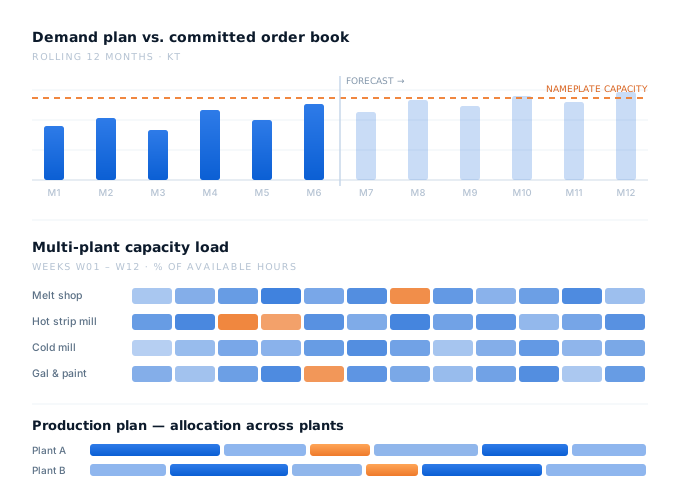
Planning dashboard showing demand plan versus committed order book, multi-plant capacity load heatmap and production plan allocation.
The plan the schedulers are executing against
Upstream

Schedulers only work if the plan is real

A perfect caster sequence against an impossible monthly plan is still a late order. Our planning layer sets the horizon the schedulers execute inside — and takes feedback when reality disagrees.

Design Partner Program · open

Bring us your worst sequencing problem.

The fastest way to evaluate a scheduler is to point it at the week that went wrong. Send us a real order book and a real constraint set, and we will show you what it produces.